
Most people think the biggest risk in a home improvement project is bad workmanship.
That’s part of it.
But in a lot of cases, the bigger risk shows up before the work even starts.
Money changes hands.
Then the excuses start.
The contractor stops showing up.
Materials never arrive.
The timeline keeps moving.
Phone calls stop getting returned.
At that point, the drywall problem, painting problem, roofing problem, or remodeling problem isn’t even the main issue anymore.
Now you have a contractor problem.
I’ve said this before, and I believe it more every year:
Most homeowners don’t actually fear the repair itself.
They fear hiring the wrong person.
And honestly, that fear is justified.
I’ve heard plenty of stories around Worcester and throughout Worcester County:
- large deposits taken and work never started
- jobs abandoned halfway through
- contractors disappearing after demolition
- homeowners paying for “materials” that never showed up
- poor workmanship followed by zero accountability
That’s not rare enough.
So let’s talk about something most contractors never bring up.
Escrow.
It may be one of the best tools homeowners can use to protect themselves.
What Is an Escrow Account for Contractor Payments?
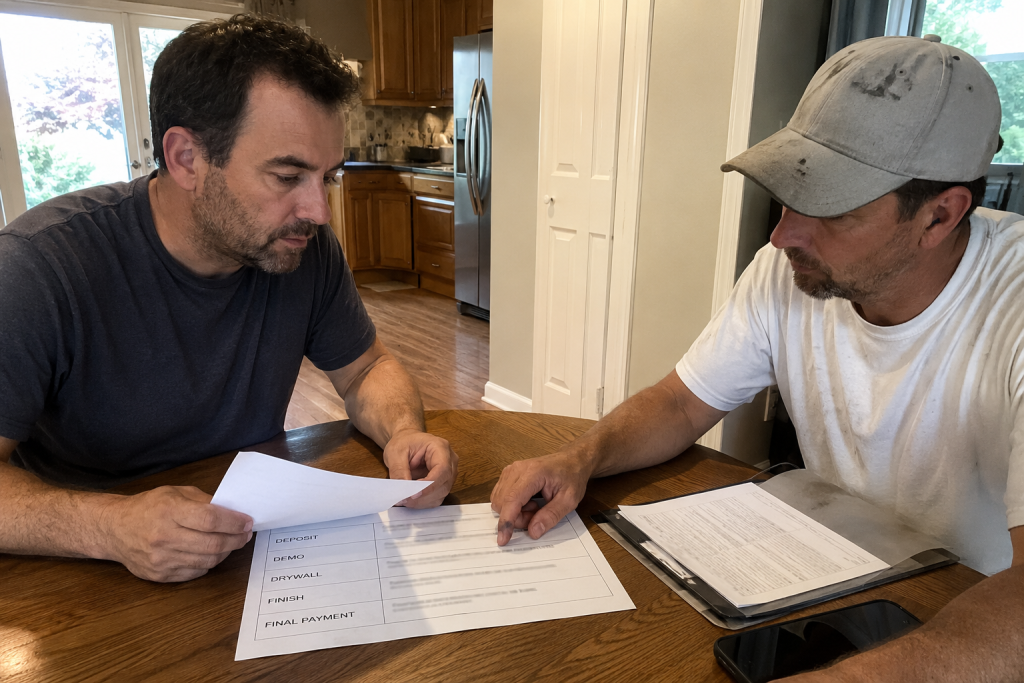
An escrow account is a neutral third-party account that holds project funds until agreed milestones are completed.
Instead of paying the contractor directly upfront, the homeowner deposits money into escrow.
The money stays there.
Nobody touches it until predetermined conditions are met.
For example:
- deposit funded into escrow
- demolition completed
- drywall hung
- drywall finished
- painting completed
- final walkthrough approved
At each milestone, funds are released.
Simple.
The contractor knows the money is there.
The homeowner knows the money is protected.
That changes everything.
The Surface Problem vs the Real Problem
A homeowner might say:
“I’m worried about getting scammed.”
That’s the surface problem.
The real problem underneath is trust.
They’re thinking:
What if I pay too much upfront?
What if they disappear?
What if the work is bad?
What if I have no leverage once payment is made?
That’s the real issue.
And most people don’t talk about it directly because they don’t want to offend the contractor.
I understand that.
Good homeowners don’t want conflict.
They just want the job handled correctly.
But here’s something important:
A good contractor shouldn’t be threatened by transparency.
In fact, the right contractor should welcome systems that create clarity.
What Most Homeowners Miss
Here’s what many people miss.
Getting ripped off usually doesn’t happen all at once.
It happens in stages.
It often starts with one of these:
Large Upfront Payment Requests
A contractor asks for 50%, 70%, or even more before meaningful work begins.
Sometimes they justify it with:
“I need materials.”
Maybe.
Sometimes that’s legitimate.
Sometimes it’s not.
Vague Payment Schedules
If the payment terms sound like this:
- half now
- half later
That’s not enough detail.
Later when?
After what?
Based on whose definition of complete?
That lack of clarity creates problems.
Undefined Scope
This causes constant conflict.
If nobody clearly defined:
- what gets repaired
- what gets replaced
- what materials are used
- what finish level is expected
Then expectations become subjective.
That’s dangerous.
Cheap Contractor vs Professional Contractor
This is where the difference becomes obvious.
Cheap / High-Risk Approach
The wrong contractor often wants:
- large cash deposit
- vague scope
- fast signature
- little documentation
- loose expectations
Why?
Because ambiguity benefits them.
The less defined everything is, the easier it becomes to shift responsibility later.
They may say things like:
“We’ll figure it out as we go.”
That sounds easy.
It usually isn’t.
Professional Approach
A professional contractor wants clarity.
They want:
- written scope
- payment milestones
- material specifications
- realistic expectations
- documented change orders
That protects both sides.
And that’s where escrow fits perfectly.
Why Escrow Changes the Power Dynamic
Escrow removes the biggest imbalance in most projects.
Normally, one side carries most of the risk.
Usually the homeowner.
Once money leaves your account and enters theirs, leverage changes.
Escrow balances that.
Here’s why.
The Contractor Gains Confidence
The contractor knows:
- funds are real
- homeowner is serious
- payment exists
- money is reserved for the project
That reduces payment uncertainty.
The Homeowner Gains Protection
The homeowner knows:
- money won’t disappear
- funds release only after progress
- contractor must perform to get paid
- disputes are easier to resolve
That reduces scam risk.
Both parties benefit.
That’s what a good system looks like.
Would Good Contractors Accept Escrow?
Some would.
Some wouldn’t.
That alone can tell you a lot.
Let me be clear.
Not every contractor who refuses escrow is dishonest.
There can be legitimate reasons.
But if a contractor becomes highly defensive, angry, or evasive the moment accountability enters the conversation, pay attention.
That reaction tells you something.
A confident contractor usually doesn’t panic when structure is introduced.
They may negotiate terms.
That’s normal.
But professionalism and transparency usually go together.
Escrow Works Best on Larger Projects
For a small drywall patch or minor paint repair, escrow may be unnecessary.
I wouldn’t overcomplicate a small one-day repair.
But for bigger jobs?
Absolutely worth considering.
Examples:
- full interior painting
- major drywall installation
- kitchen remodel
- bathroom remodel
- basement finishing
- deck rebuild
- roofing
- large water damage restoration
That’s where project size increases risk.
And bigger money attracts bigger problems when the wrong contractor is involved.
A Better Payment Structure
Here’s a practical example.
Let’s say you’re doing a $30,000 renovation.
Instead of paying huge sums upfront, structure milestones.
Example:
Milestone 1 — Deposit into Escrow
Funds reserved.
Milestone 2 — Demo Complete
Partial release.
Milestone 3 — Structural / Drywall Phase Complete
Partial release.
Milestone 4 — Paint / Finish Work Complete
Partial release.
Milestone 5 — Final Walkthrough
Final release.
Now both sides have protection.
That’s a much healthier arrangement.
The Truth Most Contractors Won’t Say
Here’s something worth thinking about.
Many homeowners assume the safest contractor is the one with the lowest price.
I’d argue that’s often backwards.
The lowest bidder frequently has the highest probability of cutting corners.
Why?
Because math still exists.
If the number is too low, something has to give.
Usually that means:
- labor quality
- materials
- prep
- time on job
- cleanup
- attention to detail
Or worse—
cash flow problems.
And cash flow problems create desperation.
Desperate contractors make bad decisions.
That’s when deposits get misused.
Can Escrow Guarantee You’ll Never Get Ripped Off?
Nothing guarantees perfection.
Let’s be honest.
A bad contractor can still do bad work.
Escrow doesn’t magically create craftsmanship.
But it dramatically reduces one major risk:
Financial vulnerability.
There’s a difference between hiring wrong and losing money.
Escrow helps prevent the second one.
That matters.
Final Thoughts
Most people think home improvement is about drywall, paint, plaster, or remodeling.
A lot of the time, it isn’t.
It’s about trust.
The wall isn’t the real problem.
The ceiling stain isn’t the real problem.
The real problem is uncertainty.
Can this person actually do what they say?
Can I trust them in my home?
Can I trust them with my money?
An escrow system doesn’t answer every question.
But it creates accountability.
And accountability filters out a lot of bad actors.
At the end of the day, it’s simple.
Good contractors shouldn’t be afraid of clarity.
Bad contractors usually are.
There’s a difference between hoping a contractor does the right thing and building a system where they have to.
That difference matters.
The right contractor shouldn’t be afraid of transparency, clear expectations, or accountability.
If you’re trying to make the right decision and want a straightforward opinion on your project, feel free to reach out.
Or call us at 508.981.3254 No pressure. Just clear answers.
FAQ
Should I always use escrow with contractors?
Not always. Small repairs usually don’t need it. Larger projects benefit much more.
How much should I pay upfront to a contractor?
That depends on job size, materials, and state law, but large upfront payments without structure should raise concern.
Can escrow prevent contractor scams?
It significantly reduces payment-related scams by protecting funds until milestones are completed.
Is escrow expensive?
Compared to losing thousands to fraud or abandonment, escrow fees are usually minor.