
The fastest way to get burned by a contractor usually isn’t price.
It’s vagueness.
Most homeowners think the biggest red flag is an estimate that’s too high.
Sometimes it is.
But a much more dangerous red flag is something people overlook all the time:
Not knowing exactly what they’re paying for.
That’s where a lot of contractor problems begin.
Not during demolition.
Not during drywall.
Not during painting.
Before any work starts.
At the estimate.
I’ve said this before, and I’ll say it again.
Most people don’t have a drywall problem.
They have a contractor problem.
And one of the biggest contractor problems is unclear expectations.
What Is a Scope of Work?
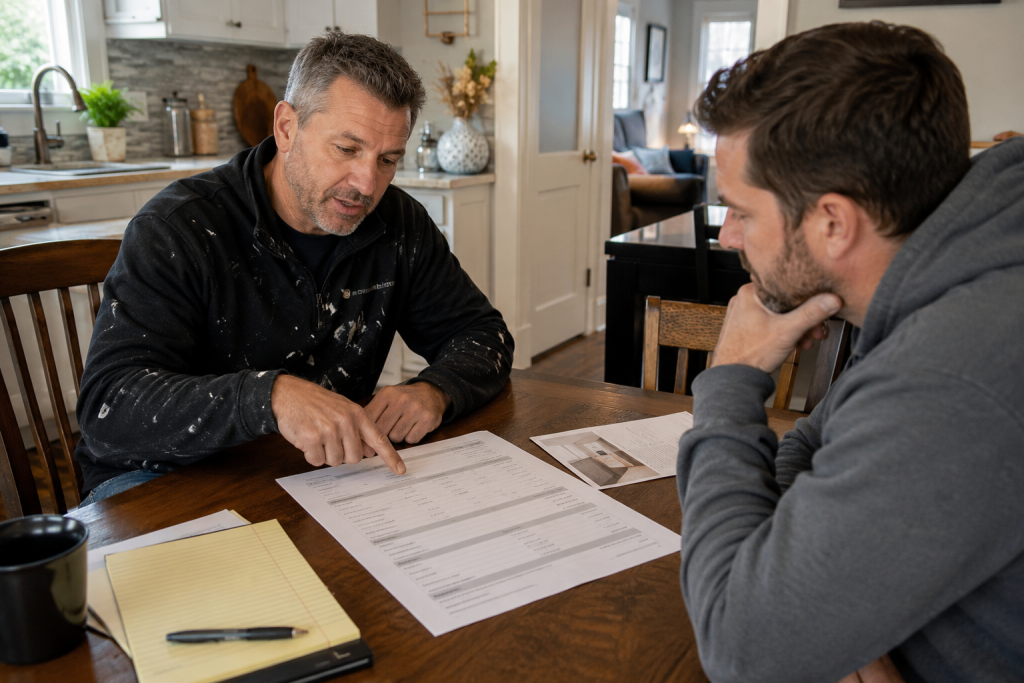
A scope of work is a written document that clearly defines what work is being performed.
That sounds simple.
But this is where things often go wrong.
A real scope of work should explain things like:
- what is being repaired, removed, or installed
- what materials are being used
- what prep work is included
- what finish level is expected
- what is not included
- what conditions may change pricing
That last one matters more than most homeowners realize.
Because once work starts, surprises happen.
Especially in older homes around Worcester and throughout Worcester County.
I see it all the time.
You open a ceiling for water damage and suddenly discover:
- wet insulation
- hidden mold
- cracked framing
- old plaster separation
- multiple prior repairs
The visible damage was never the whole problem.
It rarely is.
The Surface Problem vs the Real Problem
A homeowner might say:
“I just need this ceiling repaired.”
That’s the surface problem.
The real problem underneath is usually something deeper.
They’re really wondering:
Will this actually be fixed right?
Will the final result look good?
Am I going to get hit with surprise charges?
Is this contractor telling me everything?
That’s the real issue.
Trust.
The scope of work helps solve that.
What Most Homeowners Miss
Here’s what most people miss.
Two contractors can bid the same job.
One quotes $3,000.
One quotes $4,500.
Most homeowners immediately compare the numbers.
That’s understandable.
But here’s the problem.
You may not be comparing the same job.
That’s where people get burned.
One contractor may include:
- full protection of floors and furniture
- removal of damaged material
- moisture testing
- proper drying time
- new drywall installation
- tape and multiple coats of compound
- sanding between coats
- texture blending
- primer
- finish paint
The other contractor may include:
- patch
- sand
- paint
Those are not equal scopes.
Not even close.
But if the scope isn’t written out, many homeowners don’t realize that.
They think they’re comparing price.
They’re not.
They’re comparing assumptions.
That’s dangerous.
Cheap Scope vs Proper Scope
This is where things usually become clear.
Cheap / Vague Scope
A vague estimate might look like this:
Repair ceiling — $2,500
That’s it.
One line.
No details.
No materials.
No process.
No exclusions.
No finish expectations.
That should make you pause.
Why?
Because vague language creates flexibility.
And flexibility usually benefits whoever wrote the estimate.
Not the homeowner.
If the scope isn’t specific, phrases like these start appearing later:
“That wasn’t included.”
“That’ll cost extra.”
“I assumed you meant something else.”
“We never discussed that.”
That’s how conflict starts.
Proper Scope
A professional scope should create clarity.
Something more like:
- Protect work area with plastic and floor coverings
- Remove all loose and damaged ceiling material
- Inspect exposed substrate for additional damage
- Install new drywall
- Tape joints and apply multiple finish coats
- Sand smooth between coats
- Match existing texture as closely as possible
- Spot prime repaired areas
- Apply finish paint to repaired section
Now everyone understands the job.
That changes everything.
Why Some Contractors Avoid Detailed Scopes
This is the part many contractors won’t talk about.
Some avoid detailed scopes because they don’t actually think through the job.
Others avoid them intentionally.
Why?
Because vagueness protects them.
The less defined the project is, the easier it becomes to:
- rush
- skip prep
- substitute materials
- cut corners
- charge extra later
Now, to be fair, not every vague estimate comes from bad intentions.
Some contractors simply aren’t organized.
But from the homeowner’s perspective, the result can be the same.
Confusion.
Misaligned expectations.
Conflict.
A Written Scope Protects Good Contractors Too
This is important.
A scope of work doesn’t just protect the homeowner.
It protects good contractors too.
I actually prefer clarity.
Why?
Because clear expectations reduce unnecessary friction.
Everyone knows:
- what’s included
- what isn’t
- what may change
- what the finish should reasonably look like
That matters, especially with repairs.
Take texture matching.
I’m always straightforward about that.
Can we get it close?
Usually, yes.
Can anyone guarantee a perfect invisible match on every texture?
No.
That would be dishonest.
A written scope gives space to set realistic expectations.
That protects both sides.
Questions Every Homeowner Should Ask
Before hiring a contractor, ask these questions:
What exactly is included?
Not broad answers.
Specific answers.
What is NOT included?
This may be even more important.
What materials are being used?
Brands matter. Quality matters.
What happens if hidden damage is discovered?
You need a process for that.
What finish should I realistically expect?
Especially for repair work.
Ask direct questions.
A good contractor shouldn’t be bothered by that.
In fact, they should appreciate it.
Red Flags to Watch For
Be cautious if a contractor:
- avoids written details
- dismisses questions
- becomes irritated by clarification
- says “don’t worry about it” repeatedly
- rushes you to sign
That last one matters.
Pressure usually benefits the person applying it.
Good contractors don’t need confusion to win work.
Final Thoughts
At the end of the day, a written scope of work isn’t really about paperwork.
It’s about clarity.
And clarity reveals a lot.
It reveals whether the contractor understands the job.
It reveals whether they’re thinking ahead.
And sometimes, it reveals whether they’re intentionally leaving room to maneuver later.
The right contractor shouldn’t be afraid of specifics.
They shouldn’t be afraid of questions.
And they shouldn’t be afraid of accountability.
If you’re trying to make the right decision and want a straightforward opinion on your project, feel free to reach out.
No pressure. Just clear answers.
FAQ
Is an estimate the same as a scope of work?
No. An estimate usually provides pricing. A scope of work explains exactly what is being done.
Can a small repair still need a scope of work?
Yes. Even small jobs benefit from written clarity, especially if multiple steps are involved.
Should everything be in writing?
For meaningful work, yes. Clear written expectations reduce misunderstandings.
What if a contractor refuses to provide details?
That should be considered a major red flag.