
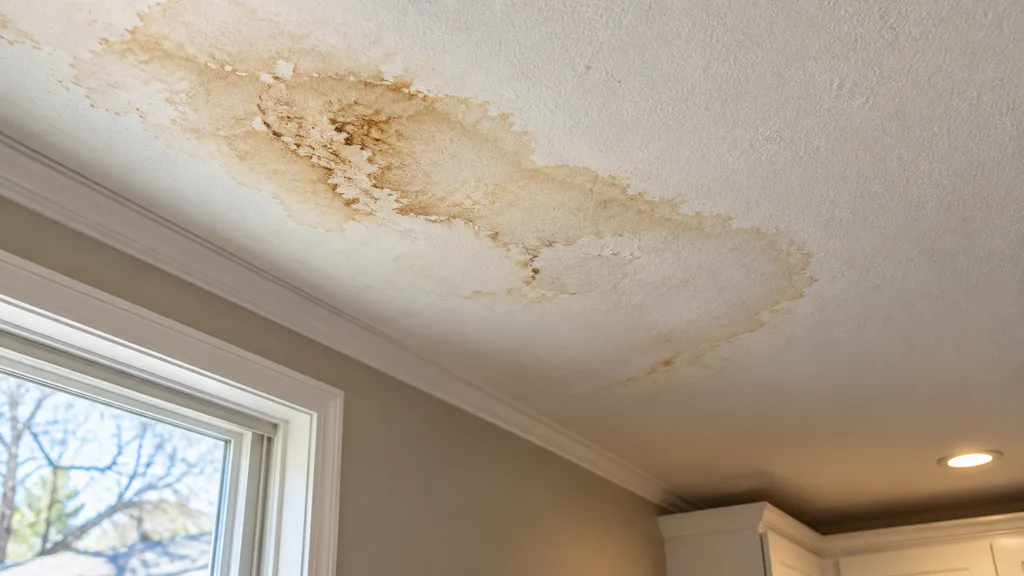
You notice a brown stain spreading across the ceiling.
Or maybe a pipe leaked and now the bottom of the wall feels soft. The paint is bubbling. The drywall looks swollen. You know water got where it wasn’t supposed to go, and now you’re trying to answer what seems like a simple question:
Does the drywall need to be replaced?
Sometimes it does.
Sometimes it doesn’t.
Before I make that decision, I want to know something more important:
What actually got wet?
A water stain tells us where the problem became visible. It does not necessarily tell us where the water started, how far it traveled, what materials it reached, or whether those materials have dried.
That distinction matters because a good water-damage repair is not simply about cutting out stained drywall.
It is about understanding what happened to the building assembly and repairing only what the evidence tells us needs to be repaired.
Start With the Water, Not the Drywall
When homeowners call about water-damaged drywall, their attention is naturally on the wall or ceiling.
That’s what they can see.
But drywall may only be where the problem finally showed itself.
Water can enter through a roof, plumbing connection, appliance, window, foundation area, overflow, condensation condition, or another source. Once it gets into a building, it can move along framing, through insulation, across surfaces, and into adjoining materials.
That means the stain directly above your kitchen table is not necessarily directly below the original leak.
Before worrying about whether the drywall needs a patch or a larger replacement, I want to know:
Where did the water come from, and has that problem been corrected?
If the answer to the second question is no, I would not consider the drywall problem solved.
You can make a damaged ceiling look new again. But if water continues entering the assembly, you have restored the appearance without correcting the condition that damaged it.
Eventually, the house may remind you that the original problem is still there.
A Small Water Stain Doesn’t Always Mean a Small Problem
This is where water damage can be misleading.
You might see a stain twelve inches across and reasonably assume the affected area is about twelve inches across.
Maybe it is.
But the visible boundary of a stain and the actual boundary of moisture are not always the same thing.
Water can exist above a ceiling, inside insulation, along framing, behind trim, or inside a wall cavity without producing an equally obvious mark on the finished surface.
That doesn’t mean every water stain requires opening half the house.
It means we shouldn’t pretend the visible stain tells us something it doesn’t.
The stain is evidence.
It is not the entire diagnosis.
When the circumstances suggest that moisture may have traveled beyond the visible damage, the surrounding materials deserve further evaluation.
Does Wet Drywall Automatically Need to Come Out?
No.
I don’t believe a homeowner should be told that drywall needs replacement simply because it got wet.
The better question is:
What condition is the drywall in now?
Water affects materials differently depending on the amount of moisture, length of exposure, location, surrounding conditions, and ability of the material to dry.
Drywall that has become badly swollen, soft, sagging, deteriorated, or unable to perform reliably may need replacement.
A localized area that was exposed to moisture but remains sound may present a different decision.
That is why I don’t like arbitrary repair rules.
The decision should follow the condition.
If the drywall can remain and continue performing reliably, unnecessary demolition does not improve the repair.
If the drywall has been compromised to the point where I would not trust it as part of the finished wall or ceiling, saving it simply to reduce the scope does not improve the repair either.
The objective is not maximum demolition.
It is not minimum demolition.
It is the appropriate amount of work for the condition that actually exists.
Time Matters, but It Isn’t the Only Thing That Matters
Homeowners sometimes hear rules such as, “If drywall has been wet for a certain number of hours, it automatically has to be replaced.”
I would be careful with rules that simple.
Time absolutely matters.
The longer unwanted moisture remains in a building assembly, the more opportunity there is for materials to deteriorate and for the repair boundaries to change.
But time is only one part of the evaluation.
You also need to consider what got wet, how wet it became, the type of material involved, whether contamination is a concern, whether the material can dry successfully, and whether it still performs the function it is supposed to perform.
Two walls exposed to water for a similar period do not necessarily end up in the same condition.
That is why inspection matters more than a stopwatch.
The Type of Water Matters Too
Not every water event should be treated as though the water itself presents the same conditions.
A sanitary plumbing leak is different from water containing contaminants.
That difference can affect what materials can responsibly remain, what cleaning or removal may be necessary, and what safety precautions are appropriate.
For homeowners, the important point is simple:
Don’t make the repair decision based only on how the drywall looks.
Where the water came from can be just as important as where it ended up.
If there is uncertainty about contamination or the appropriate cleanup procedure, that should be resolved before moving into ordinary drywall reconstruction.
Drywall Is Only One Material in the Assembly
Suppose we remove a damaged piece of ceiling drywall.
What is above it?
Maybe framing.
Maybe insulation.
Maybe plumbing.
Maybe electrical components.
Maybe additional moisture.
The drywall repair cannot be evaluated responsibly without considering the materials around it.
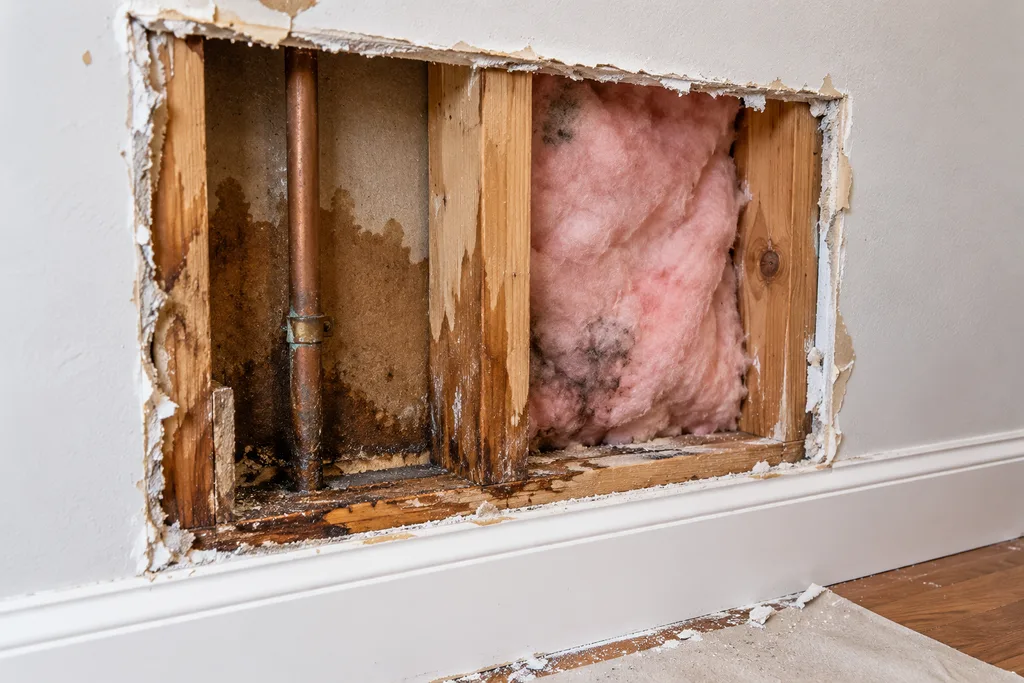
This is especially important when insulation has been affected or when water has entered a concealed cavity.
The new piece of drywall may look perfect from the room below, but appearance cannot tell us whether everything behind it was ready to be closed.
That is why reconstruction should come after the affected assembly has reached appropriate moisture conditions.
Closing a wall or ceiling too early can trap a condition that should have been addressed first.
Drying Comes Before Rebuilding
This sounds obvious when you say it out loud.
Wet building materials should be allowed to reach appropriate moisture conditions before we close the assembly and restore the finish.
But on a real project, there is understandable pressure to get the room back together.
The homeowner wants the hole closed.
The ceiling looks unfinished.
Furniture may be displaced.
Daily life has been interrupted.
I understand that.
But the sequence still matters.
Putting new drywall over an assembly that isn’t ready doesn’t make the drying problem disappear. It makes the problem harder to see.
A responsible sequence is generally:
- Identify and stop the water source.
- Determine what materials were affected.
- Remove materials that cannot responsibly remain.
- Allow affected materials that can remain to dry appropriately.
- Confirm the assembly is ready for reconstruction.
- Rebuild and finish the damaged area.
The goal is not to keep a house opened longer than necessary.
The goal is to avoid closing it sooner than we should.
Water-Damaged Ceilings Deserve Extra Attention
Ceilings behave differently from walls.
Gravity is always working on them.
If drywall has lost strength after water exposure, sagging or deformation deserves attention. Fastening, framing support, joint placement, surface flatness, and the condition of the surrounding ceiling all influence the repair.
Lighting matters too.
A ceiling repair can be structurally sound and still look poor if the transition between new and existing work is not finished properly. Natural light and ceiling fixtures can reveal humps, depressions, joint lines, and differences in texture that were not obvious during the repair.
So when I’m deciding whether a damaged ceiling should receive a localized repair or a larger replacement, I’m thinking about two things:
Can the existing material continue performing reliably?
And:
Can the repair be integrated into the surrounding ceiling at an acceptable finish quality?
Those are different questions, and both matter.
Worcester Homes Can Add Another Layer to the Decision
Throughout Worcester and surrounding Worcester County, we work in homes from many different periods of construction.
That means opening an area that looks like a straightforward drywall repair does not always reveal modern drywall construction behind it.
You may encounter traditional plaster, previous drywall repairs, older framing methods, multiple layers of renovation, or transitions between different materials.
That does not mean an older Worcester home automatically needs a more complicated repair.
Age alone is not a diagnosis.
It means I don’t want to assume what is behind a surface simply because I know what is common in the area.
Local experience helps me know what possibilities to look for.
The house still has to tell us what is actually there.
What About Plaster That Gets Wet?
Plaster and drywall are different systems, and I would not automatically make the same repair decision for both.
If an older Worcester home has a water-damaged plaster ceiling, the evaluation should consider the condition and stability of the plaster system itself.
A stain alone does not tell you whether the plaster has lost its ability to remain in place.
Likewise, an older surface should not automatically be removed simply because modern drywall would be easier to install.
The question remains the same:
Can the existing material continue performing reliably?
If it can, preservation may be reasonable.
If it cannot, the repair scope should respond to that condition.
What a Proper Drywall Repair Has to Accomplish
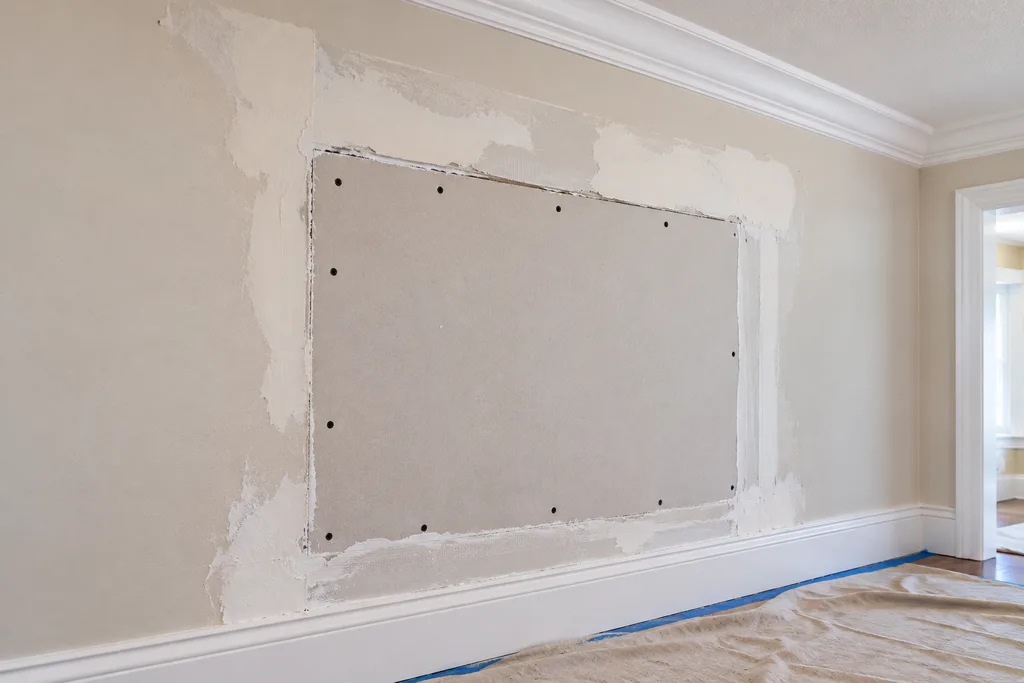
Once the moisture problem has been addressed and the assembly is ready to close, the project becomes a drywall repair.
But even then, installing a piece of drywall is only part of the job.
A successful repair has to integrate with the construction around it.
That means thinking about:
- Support and fastening
- Joint placement
- Reinforcement
- Compound application
- Feathering
- Surface flatness
- Existing texture
- Primer
- Paint
- Lighting conditions
This is where a repair that looked simple at the beginning can require judgment.
A four-foot opening does not necessarily mean the finished repair should only be considered within those four feet.
The transition into the existing surface matters.
The objective is to restore both the performance of the drywall system and the visual continuity of the room.
Can the Texture Be Matched Perfectly?
Sometimes homeowners are more worried about this than the drywall itself.
They know the damaged section can be replaced.
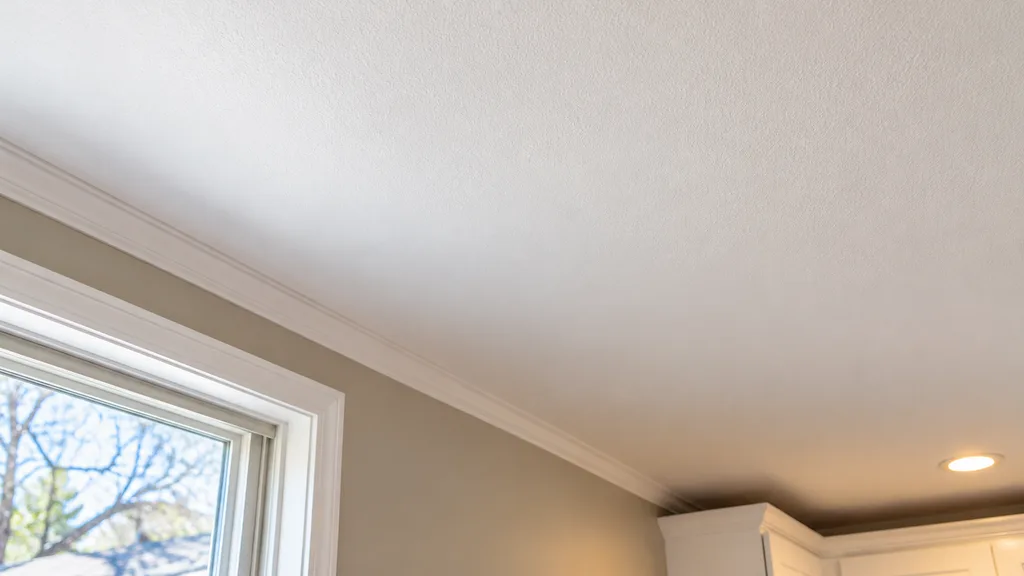
What they don’t want is to look at the ceiling every day and see exactly where the repair happened.
That’s reasonable.
Texture matching depends on the existing finish, how it was originally applied, previous repairs, layers of paint, lighting, and the size and location of the new work.
A good contractor should make a serious effort to understand and reproduce the surrounding finish.
I would be careful, however, about promising that every existing texture can be duplicated perfectly.
Some finishes have changed over decades. Some were applied by hand. Some already vary across the same room.
The more useful goal is a repair that blends naturally with the surrounding surface under normal viewing conditions.
That is a realistic standard a homeowner can evaluate.
Should You Paint Only the Repaired Area?
It depends.
After drywall finishing, the repaired area needs appropriate preparation and primer before the finish paint.
Whether you can successfully paint only a portion of the wall or ceiling depends on the existing coating, color, sheen, age, lighting, and where natural visual breaks occur.
Even when you have the original paint color, an older painted surface may have changed over time.
This is another place where I would rather set the expectation before the work begins than explain a visible difference afterward.
Sometimes a localized paint repair blends acceptably.
Sometimes painting a larger continuous surface produces the better finished result.
The condition of the room should guide that decision.
What I Would Want to Know Before Approving the Repair
If water damage happened in my own house, I would not start by asking a contractor how quickly they could patch the ceiling.
I would want to understand the condition first.
I would ask:
- Do we know where the water came from?
- Has that source been corrected?
- How far does the evidence suggest the moisture traveled?
- What materials were affected?
- Is there reason to investigate a concealed area?
- Which materials can remain?
- Which materials no longer perform reliably?
- Has the assembly reached appropriate conditions for reconstruction?
- What will it take for the finished repair to blend with the surrounding room?
- Is the proposed scope solving the water damage or simply covering the visible evidence?
A contractor should be able to walk you through that reasoning.
There may still be unknowns.
Sometimes opening a damaged area gives us information we could not responsibly claim to know beforehand.
That’s okay.
Professional judgment does not require pretending every answer is available before the work begins.
It requires being clear about what we know, what we don’t know yet, and what evidence will guide the next decision.
Repair or Replace? Let the Condition Make the Decision
This is the part homeowners usually want reduced to a yes-or-no answer.
But I don’t think that serves them very well.
If the moisture source has been corrected, the affected assembly has dried appropriately, and the drywall remains sound enough to perform reliably, preservation or a localized repair may be completely reasonable.
If the drywall has lost integrity, significant damage extends beyond the visible area, affected materials cannot be responsibly preserved, or the remaining surface cannot support a durable repair, replacement may be the stronger choice.
Neither option is automatically better.
The better repair is the one supported by the condition.
That’s the standard I would want used in my own home, and it’s the same way we approach water-damaged drywall and ceilings for homeowners throughout Worcester and the surrounding area.
If you’re dealing with water-damaged drywall and you’re not sure how much actually needs to be repaired, Drywall Paint Plus can evaluate the affected area and explain what we find before you decide how to proceed.
No-cost estimates | Fully insured | 4.9 stars on Google
Call 508.981.3254 or request an on-site estimate.
FAQ
Does water-damaged drywall always need to be replaced?
No. The decision depends on the extent and duration of moisture exposure, material condition, ability to dry, surrounding materials, water conditions, and whether the drywall can continue performing reliably.
Can you repair a water stain without replacing the drywall?
Sometimes. A stain alone does not establish that the drywall has lost integrity. The moisture source and condition of the material should be evaluated before deciding whether surface restoration, localized repair, or replacement is appropriate.
Should drywall be replaced before the wall or ceiling is completely dry?
Reconstruction should wait until the affected assembly has reached appropriate moisture conditions. Closing an assembly prematurely can conceal remaining moisture and create future repair problems.
How do I know how far water traveled behind drywall?
The visible stain may not show the complete moisture boundary. The water source, path, surrounding materials, visible conditions, and appropriate moisture evaluation help determine whether further investigation is warranted.
Can water-damaged plaster be repaired?
Sometimes. Plaster should be evaluated according to its condition and stability rather than treated automatically like drywall. Sound material may be preservable, while deteriorated or unstable material may require a different repair approach.
Can the repaired drywall or ceiling texture be matched?
Existing texture can often be blended closely, but exact matching depends on the original application, previous repairs, paint buildup, lighting, and existing variation. A realistic objective is a professional repair that integrates naturally with the surrounding surface.